
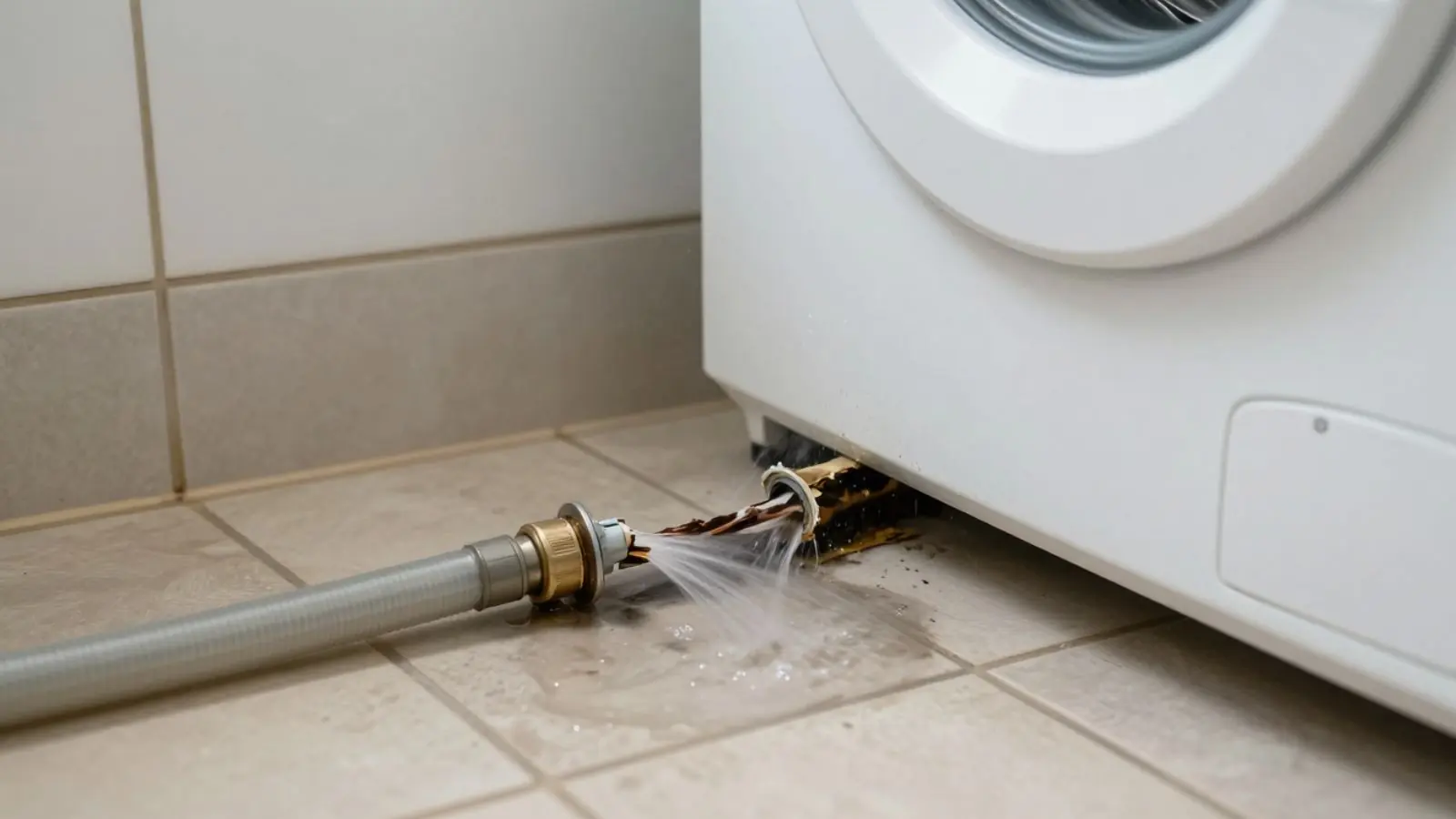
Appliance leak water damage in Evergreen, CO comes from the machines that connect to your plumbing: washing machines, dishwashers, refrigerators with ice makers, water softeners and humidifiers. Some fail with a burst hose and a flood, and others weep for months behind a panel. The line is answered 24/7, and the dispatcher helps decide whether you need a crew tonight or an inspection in the morning.
How appliances leak
Each appliance has its own weak points, and most failures happen where water meets a connector or a seal.
Washer supply hoses
Rubber hoses crack at the fittings, and a burst hose under full pressure can empty into a room quickly. Braided lines can still fail at the crimp.
Washer drain and standpipe
A drain hose that slips out of the standpipe or a clogged standpipe sends gray water over the floor.
Dishwasher door gasket and supply line
The gasket seeps during a cycle, and a loose inlet fitting leaks into the cabinet base.
Refrigerator and ice maker line
A thin plastic or copper line behind the fridge can drip for weeks before a floor shows it.
Water softener and humidifier
Drain lines and brine tanks overflow or run on.
Slow leaks versus sudden floods
The two kinds of loss feel very different, and they are handled differently. A sudden failure is obvious. A slow leak is quiet, and the damage grows in the subfloor, the sill plate and the cabinet base, which is why it is expensive to ignore.
Water that wicks into plywood subfloor swells it, loosens the finish flooring above and gives mold something to feed on. EPA homeowner guidance on mold says to dry wet materials quickly, within about 1 to 2 days, and to fix the water source first. A leak that has run for months has already missed that window, so a crew checks moisture in the framing before any new flooring goes down.
What you may notice
| Sign | What it can mean | Next step |
|---|---|---|
| Floor feels soft near the washer or dishwasher | Subfloor absorbing water | Call and ask for moisture mapping |
| Musty smell in a cabinet or laundry room | A hidden wet cavity | Check behind the appliance, then call |
| Cupped or lifting flooring in the kitchen | Moisture under the boards | Photograph it and avoid forcing it flat |
| Ceiling stain below an upper floor laundry | Water traveling through the floor | Shut the supply and call |
| Water bill rises with no change in use | A running or leaking line | Check the appliance connections |
Appliance leak safety
- Close the shutoff valve behind the appliance, or the main valve if you cannot reach it.
- Unplug the appliance only if the outlet and the floor around it are dry. If water is near the outlet, shut off the breaker or call the utility.
- Do not run a wet vacuum that is not rated for water, and keep extension cords out of standing water.
- Pull the appliance away carefully, because it can be heavy and the floor beneath may be weak.
- Photograph the model, the hose and the damage before moving anything.
Appliances on upper floors
An upstairs laundry changes the stakes. Water from a failed hose crosses the subfloor, runs down through the ceiling cavity and soaks insulation, drywall and the room below. The visible stain on the ceiling is often only a fraction of the wet area.
A crew uses moisture meters and thermal imaging cameras to trace the path of the water, then opens only the spots that need it. When the loss reaches the kitchen below, the work overlaps with kitchen water damage, where cabinets and toe kicks need special attention.
Laundry on well and septic systems
Not every home in the area connects to a public system. Evergreen Metropolitan District provides drinking water and wastewater service in its area, but homes outside that service area rely on wells and septic. If your water and sewer come from the district, an appliance leak is a plumbing problem inside your walls. If you have a well and septic tank, it is also a question about the system outside.
Jefferson County Public Health regulates septic systems, called onsite wastewater treatment systems or OWTS, in unincorporated Jefferson County. Its guidance says not to overload the system with excessive water, and a flood of washer discharge or a stuck drain can do exactly that. The county also notes that how often a tank should be pumped depends on tank size and the number of people in the household, and that actual timing can vary considerably based on your water use.
If a septic system backs up into the house or leaks at the absorption bed, the county directs people to call Jefferson County Public Health right away. Ask a licensed septic professional about the tank before running big laundry loads after a leak.
The Jefferson County plan for the Conifer corridor describes most of that area as served by individual wells and onsite septic, so a laundry leak near Conifer can involve both. In Indian Hills, part of the community is on a water district and the rest uses wells, so ask which applies to your address.
Private wells are the owner's responsibility. Jefferson County Public Health says Colorado does not regulate private well water quality, and it recommends yearly testing and a yearly inspection by a qualified well contractor. After a loss with contaminated water, ask your well contractor or the county's Environmental Health Services whether a test makes sense before drinking the water.
How the work runs
Appliance losses are usually clean supply water at the start, which is Category 1 under ANSI/IICRC S500, the published water damage restoration standard. Washer drain water and old standing water are less clean. Ask any company whether its crews work to S500 and how they log the category.
Stop the water
Confirm the supply to the appliance is closed and the leak has stopped.
Map the moisture
Moisture meters and thermal imaging cameras show what is wet under floors, behind panels and in cabinet bases.
Remove what cannot dry
Soaked pad, swollen underlayment and wet insulation come out.
Dry the structure
Air movers and LGR dehumidifiers run, with readings logged at each visit.
What changes the cost
A small leak caught early is a very different job from a subfloor that has soaked for months. The factors:
- How long the leak ran.
- Whether the water reached subfloor, insulation or a lower story.
- The type of flooring, such as tile, vinyl, hardwood or carpet.
- Whether cabinets or drywall have to be opened.
- Drying days and the equipment needed.
Want your real number? Call (303) 952-8295 and describe where the appliance sits.
Insurance and appliance leaks
Sudden and accidental water damage from a failed hose or line is often covered, while gradual leaks and neglect often are not, so the timeline of your leak matters. Check your policy and ask your insurer about limits and exclusions. The Colorado Division of Insurance advises sending an inventory of damaged property and notes that information sent in pieces slows processing. It also says to keep receipts for living costs if a covered loss makes the home uninhabitable.
Photos of the failed hose, the model number and the wet materials help your claim. Your insurer, not us, decides what a claim pays.
Habits that prevent the next leak
- Replace rubber washer hoses with braided lines and check them on a schedule.
- Turn the washer supply off at the valves when you leave on a trip.
- Pull the fridge out and inspect the ice maker line each year.
- Add leak sensors under the dishwasher and the washer.
- Look under sinks for dampness.
Soft floor or damp cabinet?
Call the 24/7 line and describe the appliance.
Frequently asked questions
Is appliance leak water damage service available in Evergreen, CO?
The line is answered 24/7. The dispatcher asks how long the leak has run and what is wet, then triages the call. An active flood is handled as an emergency, and a slow leak is scheduled for moisture mapping.
How can I tell if the washer leaked under the floor?
Look for a soft or cupped floor, a musty smell and a stain on the ceiling below. A moisture meter confirms whether the subfloor is wet, even if the surface looks fine.
My washer drains into a septic tank. Should I worry after a leak?
Ask a licensed septic professional. Jefferson County Public Health advises against overloading a system with excessive water, and a major leak adds to that load. Spread out laundry until the system is checked.
Can I test my well water after a leak?
A test is up to the well owner, since Colorado does not regulate private well quality. Jefferson County Public Health recommends yearly testing, and its Environmental Health Services office can point you to options.
Will my insurer pay for a slow leak?
Gradual leaks are often excluded, while sudden failures are often covered. Check your policy, and ask your insurer how it treats a leak that ran over time.