
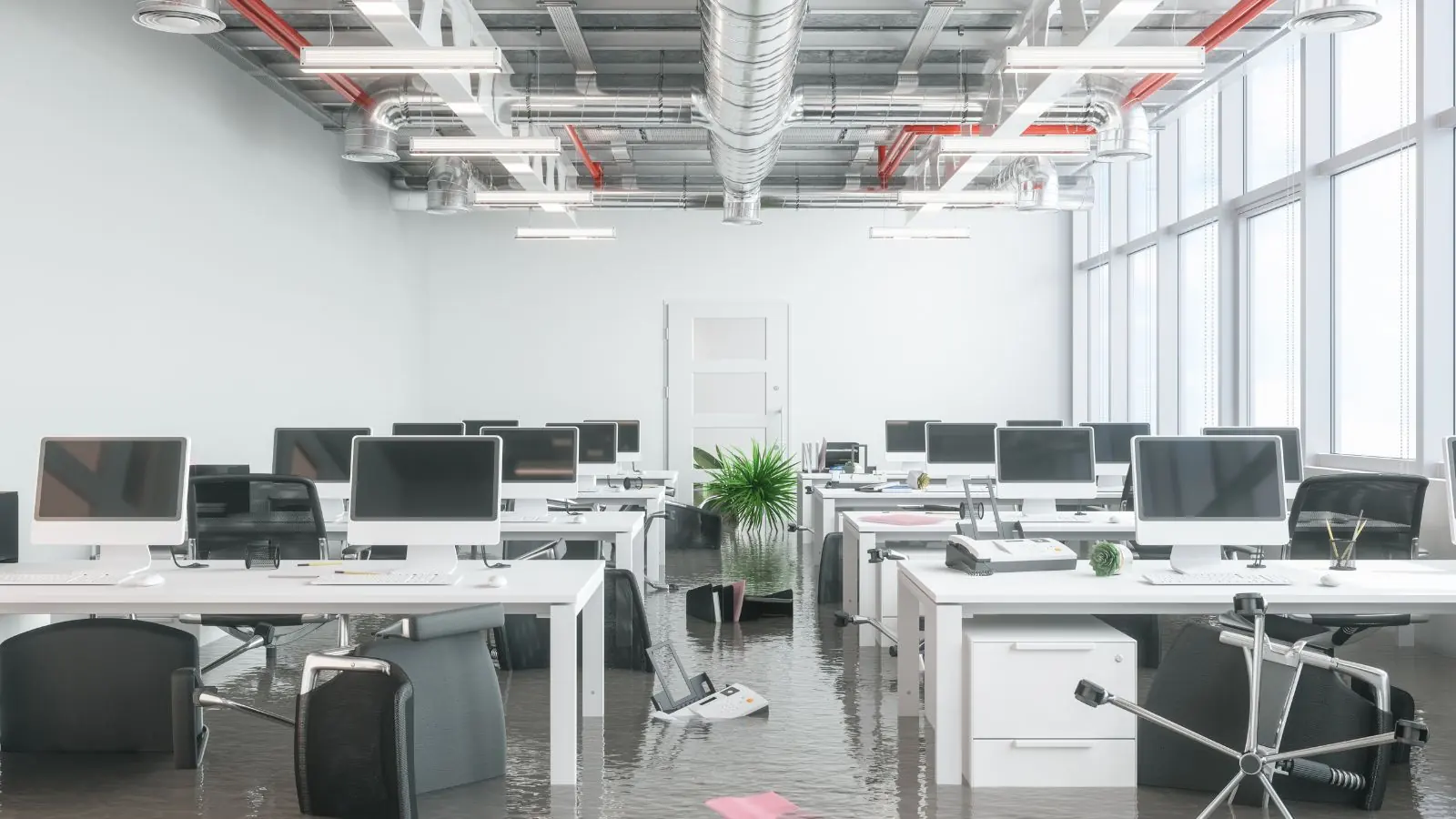
Commercial water damage restoration in Evergreen, CO covers water losses in small commercial and mixed-use buildings: a burst line above a ceiling, a roof leak into a back room, a failed water heater, a sprinkler or fixture failure, or storm water entering at grade. The crew extracts standing water, maps moisture in floors, walls and ceilings, sets drying equipment and records the work.
Dispatch answers 24/7, and the first call usually settles who needs to be in the room and who needs to be called.
This page describes what a restoration crew can do. It does not cover repairs that need a licensed trade or a structural opinion, and it does not replace the instructions from your insurer or your lease.
How a commercial loss differs from a home
A house usually has one decision maker. A commercial building often has an owner, a property manager, an operator who rents the space, a landlord's insurer and an operator's insurer, all with a stake in the same wet floor. That is why the first conversation matters more than the first piece of equipment.
Dryers are the same tools, but the constraints differ. Floor areas are larger, ceilings are higher, and finishes such as commercial carpet tile, suspended ceilings and glued flooring behave differently from household materials. Operating hours decide when noisy equipment can run and when foot traffic can be kept off wet floors.
What you see and what it may mean
| What you see | What it may mean | What to do first |
|---|---|---|
| Stained or sagging ceiling tiles | Water above the ceiling, from a pipe, roof or unit | Keep people out from under them, call |
| Wet carpet tile or lifting floor | Water on or under the slab | Photograph, call before moving anything |
| Water at a restroom or kitchen area | Fixture, supply or drain failure | Close the shut-off if safe |
| Musty smell in a closed room | Moisture in walls, ceiling or insulation | Ask for moisture mapping |
| Water on a floor near equipment | Electrical hazard | Leave the area and call a licensed electrician |
Ceiling tiles that look dry from below can still hold water above them, which is why a thermal imaging camera and moisture meter are useful in the first hour of a scope.
Commercial water safety
- Keep staff, customers and visitors away from wet floors and from areas under stained ceilings.
- Close the building's water shut-off if you know where it is and it is safe to reach. Ask the property manager or building engineer if you do not.
- Leave electrical panels, floor outlets and wet equipment alone. Call a licensed electrician or the utility if a panel is wet.
- Do not prop up or lift heavy ceiling tiles. They may be holding more water than they appear to.
- Take photos before anything is moved, and write down when the loss was found.
The scope meeting
The first meeting sets the plan, and it should include the owner or property manager, whoever holds the lease, and anyone who controls the building systems. The crew walks the affected area with moisture meters and a thermal imaging camera, confirms the water source, and identifies the category of water under the ANSI/IICRC S500 standard.
The scope lists what will be extracted, what can be dried in place, what must be removed and what is still unknown. It also records the opening schedule and which rooms must be usable first. An honest scope says what is not yet known, because moisture behind a finished wall is not visible until the readings are in.
How extraction and drying are staged
- Extraction. Pumps and extraction units remove standing water, which is much faster than leaving it for dehumidifiers.
- Moisture mapping. Meters and thermal imaging show wet slabs, wall bases, insulation and areas above the ceiling grid.
- Selective removal. Saturated ceiling tile, insulation, wet base and soaked carpet tile are removed when drying cannot save them.
- Drying setup. Air movers and LGR dehumidifiers are placed to dry the affected zone, with equipment kept out of aisles and exits where possible.
- Daily readings. Moisture readings are logged each visit, and equipment is adjusted or removed as the readings improve.
Staging around operating hours means the crew can discuss options such as running the loudest equipment when the space is closed, or drying one zone while another stays open. Some constraints cannot be changed, for example when wet material must come out before the space is safe to use. Ask for the tradeoffs in writing.
Drying and the risk of waiting
The EPA's guidance for commercial buildings says to dry wet carpet and backing within 24 to 48 hours and to discard wet ceiling tiles and insulation. EPA also says that when materials have been wet longer, or when mold has already grown, the response moves to a separate remediation table.
That time window is the practical reason to call early. Waiting through a weekend can turn a drying job into a removal job, and it can turn a short disruption into a longer closure. If mold is already visible, the next step is mold remediation, and you should ask whether your state licenses mold work.
Documentation for the owner's insurer
Good records make a claim easier to review, even though no one can promise an outcome. The crew can provide photos, the water category, a list of materials removed, a record of equipment placement and moisture readings from each visit. The owner or property manager sends those records to the insurer along with receipts and a written inventory of damaged contents.
Commercial policies differ widely, so check the policy for water damage, business interruption and any requirement to notify the insurer promptly. Sudden and accidental water damage is often covered, while gradual leaks and lack of maintenance often are not. Flood damage is usually excluded without separate flood coverage. Ask your insurer before you sign anything.
Who else may be needed
A restoration crew handles water removal and drying. Several other parties may also be involved, and the owner or manager usually coordinates them.
- The landlord or property manager, for building systems and lease questions.
- A building engineer or maintenance staff, for shut-offs, mechanical rooms and access.
- The water or sewer utility, if the cause is a main or service line.
- Licensed trades, such as a plumber to repair the leak, an electrician to check wet circuits and a roofer for a roof failure.
- A structural engineer, if floors or walls look compromised.
Permits can add to the list. In Jefferson County, Jefferson County Building Safety handles permits for unincorporated areas, including mechanical, electrical and plumbing, so ask Building Safety whether your repair needs one. The Town of Morrison Building Department covers commercial and multi-family structures in the town, and the City of Golden Building Division handles permits inside Golden. If a building is near a boundary, ask the Town which office handles it.
Nearby places that may be affected
Owners in the canyon community of Morrison deal with the town's building department and with creek flood history, and the Mile High Flood District lists 24 known floods in the Bear Creek basin since the 1860s. That history is a reminder to check flood coverage and the FEMA flood map for your address.
Owners in Golden work with the City of Golden Building Division, and a repair that touches plumbing or mechanical systems may need a permit there. The water mitigation page explains the first-days work in more general terms, and the structural drying page covers the drying stage.
What changes the cost
No honest number comes before a walk-through, but the factors are consistent.
- The area affected, including how many rooms, floors or suites.
- The water category and how long it sat.
- The materials involved, such as carpet tile, drywall, insulation and ceiling tile.
- Drying days and the amount of equipment.
- How much work must happen outside business hours.
Want your real number? Describe the loss to dispatch, and the scope is explained before work starts.
Water loss in a business space?
Call the 24/7 line and tell dispatch who manages the building.
Frequently asked questions
Is emergency commercial water damage restoration available in Evergreen, CO?
Yes. Someone answers the line at any hour, with same-day response when available. Dispatch asks where the water started, whether the space is occupied and who holds the authority to approve work, then explains the first steps.
Can drying be scheduled around our hours of operation?
Often in part. Equipment noise, foot traffic and access can be planned around the schedule, but wet materials sometimes must come out right away. The scope should state what is flexible.
What records should I keep for the insurer?
Keep photos taken before cleanup, the dates and times, receipts, a list of damaged contents and the drying logs from the crew. Send the insurer information together, because sending pieces slows processing.
Who handles a leak that started in a neighboring unit?
That depends on the lease and on who controls the building. Tell the property manager at once, document the damage, and ask the insurers involved. The crew can document what it finds, but it cannot assign fault.
Do I need a permit to repair after water damage?
It depends on the work and the location. Ask Jefferson County Building Safety for unincorporated areas, the City of Golden Building Division inside Golden, or the Town of Morrison Building Department for town structures.
How is this different from residential water damage?
The methods are similar, but a commercial job adds more decision makers, larger floor areas and schedule limits. See emergency water removal for the first-hours basics.