
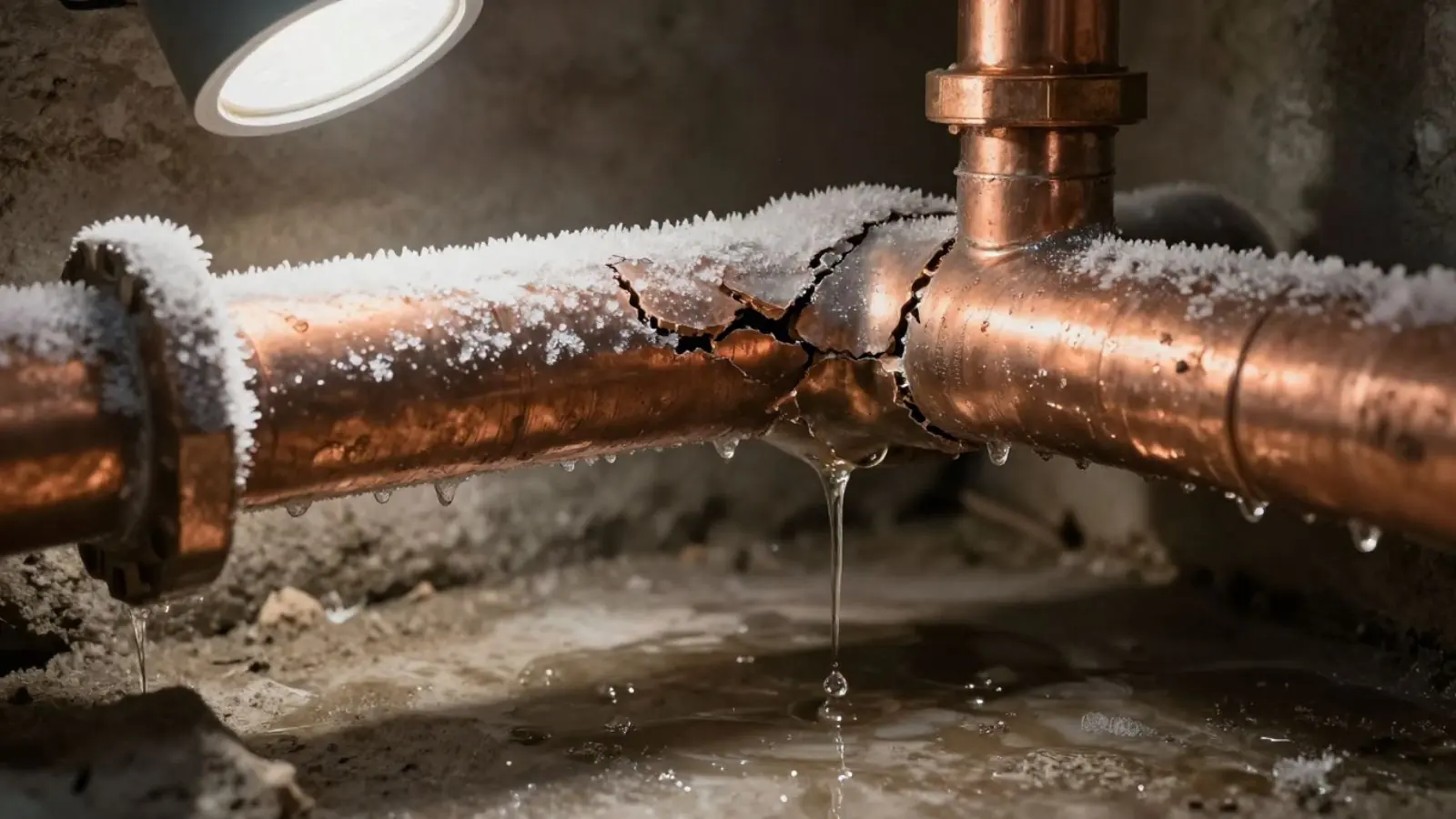
Frozen pipe water damage in Evergreen, CO starts when water inside a supply line turns to ice, expands and splits the pipe wall. The split usually stays sealed by the ice plug, so nothing leaks until the temperature climbs and the plug melts. That delay is why a homeowner can feel safe all night and then find a soaked wall by afternoon. The dispatch line runs 24/7 because thaws do not keep office hours.
Why pipes freeze in a mountain house
Evergreen sits at roughly 7,160 feet, gets roughly 80 inches of snow in an average year, and has a record low near minus 38 F, based on NOAA normals as summarized for the area. A house that is warm in the living room can still have a plumbing run in a cold pocket. Rooms over garages, kitchen sinks on exterior walls, hose bibs and lines through vented crawl spaces are the usual victims.
Water expands as it freezes, but the split rarely happens where the ice sits. Pressure builds between the ice plug and a closed faucet, and the pipe fails at its weakest point, often a fitting or a thin run of copper. So the wet spot you find may be a few feet from the cold spot that caused it.
Warning signs before and after the thaw
Some signs show up while the pipe is still frozen, and others appear only when it melts. This table links what you notice to what it may mean.
| What you notice | What it may mean | What to do |
|---|---|---|
| Faucet runs as a trickle in a cold snap | Ice partly blocking a line | Open the faucet slightly, warm the area, call if pressure does not return |
| Frost on a pipe or a bulge in the line | Ice is expanding inside | Treat the pipe as already damaged |
| Hissing or dripping inside a wall after a thaw | Split pipe now releasing water | Close the main valve and call |
| Stained ceiling below a bathroom or kitchen | Water traveling through the floor cavity | Photograph it and call before cutting anything |
| Sudden drop in pressure at every fixture | Frozen service entry or main | Check where water enters the house |
Do not wait for a drip to become a flood. A line that froze on one night often releases water on the first warm afternoon, when nobody may be home to notice.
Frozen pipe safety steps
- Close the main water valve before the ice melts if you suspect any pipe has frozen and split.
- Keep an open flame away from the pipe. The American Red Cross warns against blowtorches, kerosene or propane heaters and charcoal stoves for thawing.
- If you thaw a line, the Red Cross suggests a heating pad, a hair dryer, a space heater kept clear of anything flammable, or towels soaked in hot water, and says to keep the faucet open while you work.
- If water reaches an outlet, light fixture or breaker panel, stay away from it and call the utility or 911 before calling us.
- If you cannot find the frozen section or cannot reach it, call a licensed plumber.
What a crew does after a freeze loss
Plumbers repair the pipe, and restoration crews dry the house. Both jobs matter, and the order depends on whether water is still moving. Here is how the drying side runs.
Locate the split
A crew confirms the supply is closed and finds every wet area, including rooms below and beyond the visible stain.
Map the moisture
Moisture meters and thermal imaging cameras trace water through drywall, insulation and flooring.
Remove what cannot dry
Wet insulation, soaked drywall and saturated carpet pad are cut out and bagged.
Dry the structure
Air movers and LGR dehumidifiers run until readings in framing and subfloor match unaffected areas.
Document the loss
Photos and moisture logs go to you for your insurer.
A split supply line usually releases clean water, which falls in Category 1 under ANSI/IICRC S500, the published water damage restoration standard. That category can slide toward Category 2 if the water sits for a long time or crosses dirty surfaces, so speed still matters. Ask any company whether its crews work to S500 and how they record readings.
Drying after the thaw
The loss keeps costing you after the water stops. Insulation in a wall cavity holds moisture against the back of the drywall, and a vented crawl space loses heat to the outdoors, so wood and insulation stay wet in cold weather. Drying a cold, damp cavity takes longer than drying one in a warm room.
For that reason a crew checks readings again on each visit instead of trusting how a wall feels. If your loss is mostly under the floor, the same approach applies in a crawl space water damage job, where ventilation and ground moisture add to the work. If the damage is broader, it connects to water mitigation done in the first days.
Vacation homes and unheated spaces
A seasonal cabin is the classic setup for a big freeze loss. If heat fails while no one is there, a split line can run for days. Red Cross winter guidance says to leave the heat on, set no lower than 55 F, when you are away. Neighbors, caretakers and smart sensors can catch trouble sooner, but a shutoff when you leave is the surest way to cut the risk.
Higher areas near Conifer sit well above Evergreen in elevation, so freezes there can arrive earlier and run harder. Homes in Indian Hills outside the water district use private wells, so ask your crew to check any line between the well and the house as well as the plumbing inside.
What changes the cost of a freeze loss
No one can name an honest price before seeing the damage, but the factors are predictable.
- How long water ran before the main was closed.
- How many floors and rooms the water reached, including the ones below.
- Whether wet insulation, drywall or subfloor must be removed.
- The number of drying days and pieces of equipment needed.
- Access to the affected space, such as a tight crawl space.
Want your real number? Call (303) 952-8295 and describe where the water went.
Frozen pipes and your insurance
Sudden and accidental water damage is often covered, while gradual leaks and neglect often are not, so check your policy and ask your insurer about limits and exclusions. The Colorado Division of Insurance, in its burst pipe advisory, says damage to flooring, cabinets and contents is generally covered under homeowners and renters policies. If a covered loss makes the home unlivable, additional living expenses may apply, so keep every hotel and meal receipt.
The same advisory says to send your insurer one complete inventory of damaged property, because information sent in pieces slows processing. It also says to take steps to limit further damage but to get the insurer's instructions before making repairs. Whether a claim is paid is up to your insurer, and we make no promise about it.
Mistakes that make freeze losses worse
- Leaving the main open to see if the pipe held through the thaw.
- Using a torch or a heater with a flame, which is a fire risk and can burst a weakened pipe.
- Closing up a wet wall without a moisture reading.
- Turning the heat off in an empty house to save money.
- Assuming a single frozen line means no others froze.
Frozen line or wet wall?
Dispatch answers 24/7 and walks you through the next safe steps.
Frequently asked questions
Is emergency frozen pipe water damage service available in Evergreen, CO?
Yes. Dispatch answers 24/7, including nights, weekends and holidays, and same-day response is offered when available. The dispatcher asks where the water is, whether the main is closed and what the ceiling or floor below looks like, then sets up a crew.
My pipe is frozen but not leaking. Is there damage yet?
Possibly. The pipe may already be split, with the ice acting as a plug. Thaw it slowly with a safe heat source while the faucet is open, and stand by the main valve in case it begins to run.
Why did the water show up days after the cold snap?
The ice held the split closed until temperatures rose. When the plug melted, water ran through the opening, which is why these losses are so often found on the first warm afternoon after a freeze.
Can a split pipe behind a wall be found without tearing it open?
Often, yes. Thermal imaging cameras and moisture meters show where the water traveled, so a crew can cut a small access point instead of opening a whole wall. A plumber then repairs the pipe.
Should I stay home after a freeze loss?
That depends on the damage and on your insurer. If water reached the panel or heating system, ask a professional before staying. If a covered loss makes the home unlivable, the Colorado Division of Insurance says to keep receipts for living costs.